
Heavyocity Convergence is the kind of release you can anticipate before you open it. They have one of the most recognisable sonic identities in the sample library world: analog sources run through a hybrid processing chain that adds weight, grit, and cinematic scale, sometimes even tipping into chaotic territories. It has worked across Gravity 2, Dystropia, and Oblivion. With Convergence, it works again.
The question I keep asking these days is whether a library does something I haven’t heard before. With Convergence, the answer is: not really. But that framing only tells part of the story, and the rest is worth understanding before you decide whether Convergence might be for you.
You are currently viewing a placeholder content from YouTube. To access the actual content, click the button below. Please note that doing so will share data with third-party providers.
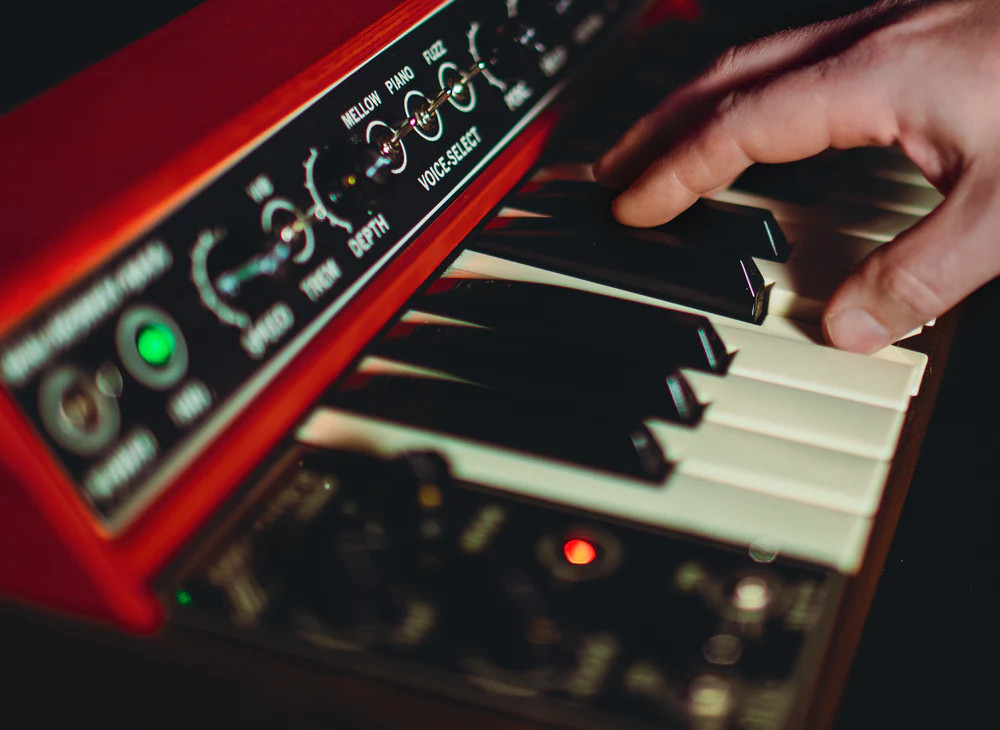
Convergence is a Kontakt instrument housed in the same Gravity 2-based engine that powered Dystropia. The sampled source material is largely analog, meaning Heavyocity recorded vintage string machines like the ARP Solina and Roland RS-202, classic polysynths like the Juno-2, and more modern hardware, including a Moog Sub 37 and Arturia MatrixBrute. All sampled sounds went through Heavyocity’s trademark production chain before landing in the sampler engine. The result is 480+ presets across nine categories, from Cue Creators and Rhythmic Pedals to Pads, Arps, and Plucks. It’s aimed squarely at darker cinematic work and 80s-influenced aesthetics, with enough range to cross over into electronic music production.
The sounds of Convergence carry the warmth and weight of real hardware, pushed into something more cinematic – darker, more textured, with a digital brittleness layered over the almost organic foundation. There’s a deliberate instability to a lot of the material: pitch drift, subtle detuning, the kind of slight wow and wobble you associate with degrading tape or a synthesizer that hasn’t been serviced in thirty years. It gives the library a specific character that’s hard to fake with purely digital sources, and it’s one of the things Heavyocity consistently does well.
Convergence source recordings – Photo by Heavyocity
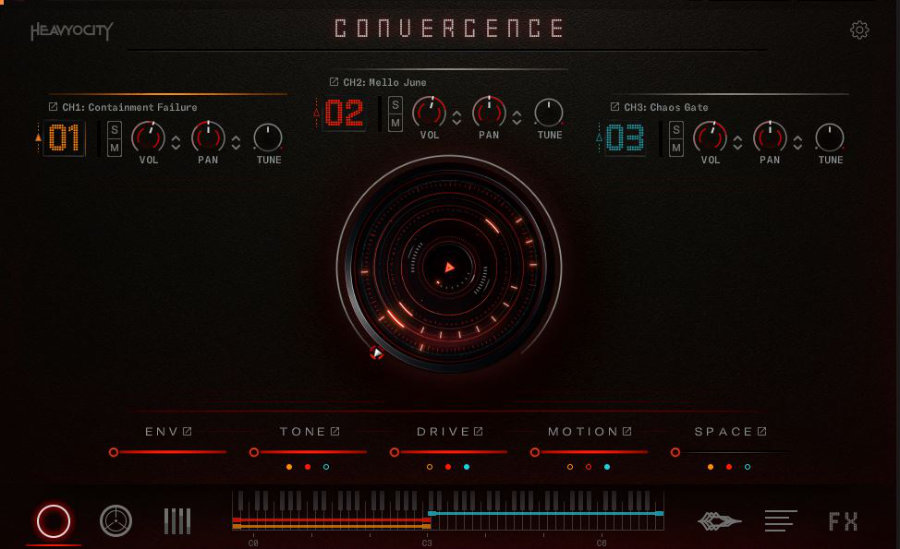
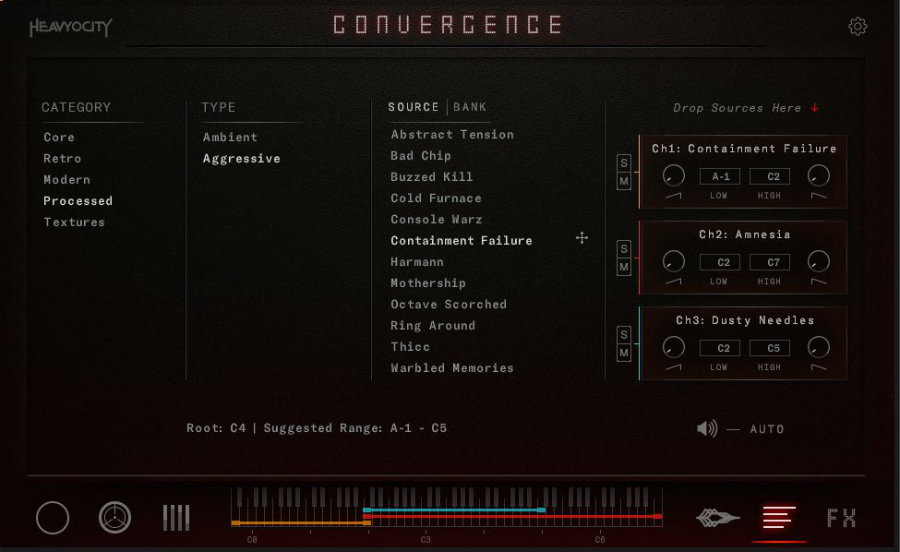
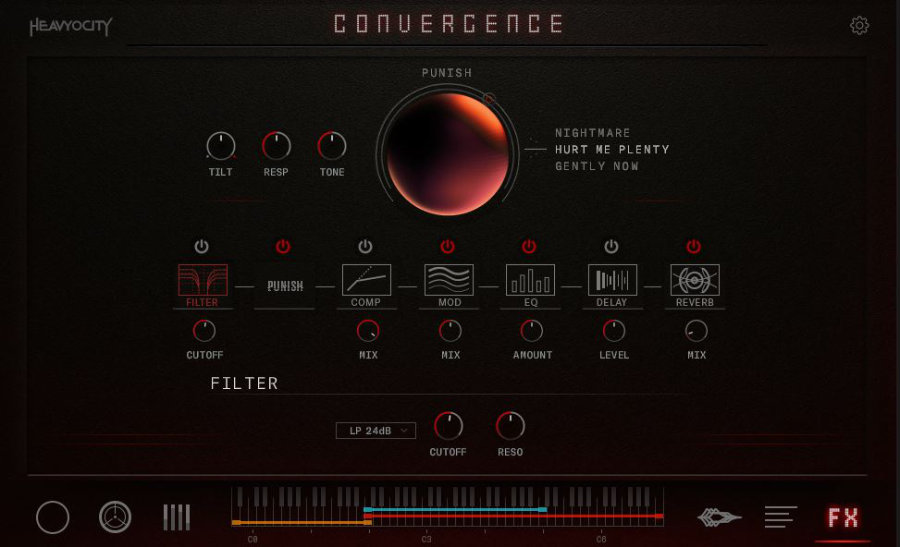
The engine itself is worth understanding if you haven’t used a Gravity 2-style instrument before. Each preset runs three sound channels simultaneously, each with its own envelope, tone controls, drive, and motion parameters. A central Macro control sits at the heart of the interface, mapped by default to your mod wheel, and it morphs between sonic states in real time: opening filters, shifting motion, evolving textures as you perform. The Macro Sequencer takes this further, letting you program that movement to run automatically and sync to your project tempo. For composers who want evolving, breathing cinematic textures without drawing automation lanes, it’s genuinely fast to use. The Source Browser lets you swap the sample source on any channel independently, which encourages the kind of cross-category experimentation that leads to sounds you wouldn’t have found any other way.
If you’ve used Dystropia, the layout is immediately familiar. The visual design has a slightly more retro-digital feel, which I understand as a nod to the analog-synth aesthetic of the source material. However, the workflow is unchanged.
I started with the Cue Creators, which is where I always start with Heavyocity libraries. They give you an excellent image of what to expect from the sample library. Hold down a single note or chord, ride the mod wheel, and something that sounds like a finished cue appears. Convergence’s Cue Creators lean dark: thick pads with digital crunch on the edges, arpeggiated patterns with subtle instability, textures that feel like vintage synthesizers being pushed past their comfort zone. The pitch drift that runs through many of these presets gives them a VHS-era quality. They sound slightly degraded, unstable, as if the signal has been duplicated onto tape one too many times. For the right project, that’s exactly the texture you want.
The Rhythmic Pedals are where the library generates momentum. Not to be confused with drum patterns, they’re sequenced, filter-driven pulses that create drive and forward motion without explicit percussion. In a trailer cue or a tension scene, they do the work of keeping things moving while leaving space for other elements to breathe. Even layering just one rhythmic pedal sound under a sustained string pad will give you propulsion without cluttering the mix. For me, they’re definitely one of the more practically useful categories in the library.
The Arps held up particularly well, too. They sound precise, mostly not over-processed, and present enough to sit in a full orchestral arrangement without disappearing completely. Heavyocity has a quality across their recent releases of sounds feeling maximally present without becoming fatiguing. Almost as if the levels and tone have been calibrated for the specific context of cinematic mixing rather than demo playback. The Arps in Convergence are a good example of that.
The pitch drift that runs through many of these presets gives them a VHS-era quality. They sound slightly degraded, unstable, as if the signal has been duplicated onto tape one too many times. For the right project, that’s exactly the texture you want.
The Plucks and Stabs are punchy and full-bodied in a way that makes them immediately useful for scoring accents. Without being too thin or too soft, they sit right in the zone of satisfying weight that translates well to trailer and sync work where transient clarity matters. Use them sparingly, as punctuation, and they earn their place quickly.
The Pads carry that same pitch drift that runs through the Cue Creators. Some of them are genuinely beautiful, carrying a slowly evolving, detuned quality, with a warmth that doesn’t smear as much in the low-mids the way many cinematic pads do. They work as emotional support in dialogue scenes, as well as in large-scale atmospheric beds. A simple two or three-note voicing, some slow mod wheel movement, and you have something that feels alive and always interesting to the ear.
Keys, Leads, and Basses round out the library. The leads are sharper and more laser-focused than I expected from an “analog-style” library. They are useful precisely because they don’t spread too wide, which means they can sit alongside other elements without dominating. The basses are heavy and analog in character, often pushing to the edge of distortion. The keys and leads cover a familiar ground of warm, well-behaved sounds that are easy to place in a mix. To my ears, they sound reliable rather than revelatory (in a good way), which of course has its own value when you need to move fast.
Convergence has a clear visual and sonic identity, and it maps cleanly onto a specific cultural moment. Think Stranger Things, Tron Legacy, Alien, Drive, Ex Machina. The combination of a vintage analog sound and digital degradation is exactly what those productions share. A sound that feels like it’s been retrieved from a point in time when those synthesizers defined the emotional vocabulary of science fiction and horror, before they became a style reference.
For composers working in that territory, this is an immediately useful library. But it’s worth noting that the aesthetic extends further than film and television. A significant portion of the sounds translates directly to electronic music production: progressive house, melodic techno, the kind of layered, emotionally charged electronic music associated with artists like Anyma, Tale Of Us, or Gesaffelstein. If you’re producing music in that world alongside your scoring work, Convergence pulls double duty in a way that more purely cinematic libraries don’t.
John Carpenter‘s scores are an obvious reference point, as are Cliff Martinez‘s work on Drive and Ben Salisbury and Geoff Barrow‘s soundtracks for Ex Machina and Annihilation. The shared thread is analog hardware processed into something slightly alien. Sounds that are familiar enough to feel human but unstable enough to feel strange and otherworldly. Convergence occupies that space quite well.
As expected, with Convergence, Heavyocity’s trademark analog recording process is clearly audible, and the presets are well-programmed and immediately usable. This is a solid, well-executed library in the established Heavyocity manner.
The honest assessment depends on where you are with synthesizers and cinematic sound design tools. If you don’t yet own a Heavyocity instrument built on the Gravity 2 engine, Convergence or Dystropia would be the natural starting points and a strong introduction to Heavyocity’s world of sounds. The three-channel architecture, the Macro system, and the Cue Creators approach give you a genuinely fast workflow for cinematic texture work, and the sound quality justifies the price.
If you already own several synth-based libraries and have a reasonable collection of software (or even analog) synthesizers and effect plugins, the calculation is different. Convergence is an interesting addition to the palette rather than something that fills a clear gap in the market. The sounds are good, and the workflow is tested and efficient. But if your template already has analog sound design covered from multiple angles, you’re adding colour rather than solving a problem. Before buying, Heavyocity’s own walkthroughs, preset playthrough videos, and composing workshops are worth watching. They give you a good idea of what the library actually sounds like in use, and a good read on whether this aesthetic fits your work.
For composers still building their toolkit and who work in darker cinematic territory, it’s a straightforward recommendation. For those further along, the answer depends less on the quality of the library and more on whether that specific analog-synth character is something you find yourself reaching for or wishing you had in your palette.
Pros
analog source material with real character
Fast, proven workflow through the Gravity 2 engine
Useable for both cinematic and electronic music production
Sound quality holds up across all categories
Cons
Relatively familiar territory for existing Heavyocity users
RECOMMENDED: 8/10
Heavyocity Convergence is available at Heavyocity for $149. Registered owners of Dystropia, Oblivion, or Gravity 2 save an additional $20.
Tech Specs
Format
Kontakt 7 instrument (.nki)
Engine
Based on Gravity 2 engine
Player
Kontakt 7.10.9 or later — free Kontakt Player supported
Download size
9.42 GB
Presets
480+ across 9 categories
Sound sources
130+ analog sources
Integration
NKS2 — VST, AU, AAX, Standalone
macOS
13, 14, 15 (latest update)
Windows
10 or 11, latest service pack
CPU / RAM
Intel Core i5 or equivalent, 4 GB RAM minimum
Crossgrade
–$20 for owners of Dystropia, Oblivion, or Gravity 2
Convergence – Product Overview
You are currently viewing a placeholder content from YouTube. To access the actual content, click the button below. Please note that doing so will share data with third-party providers.
You are currently viewing a placeholder content from Turnstile. To access the actual content, click the button below. Please note that doing so will share data with third-party providers.
You are currently viewing a placeholder content from Vimeo. To access the actual content, click the button below. Please note that doing so will share data with third-party providers.
You are currently viewing a placeholder content from YouTube. To access the actual content, click the button below. Please note that doing so will share data with third-party providers.
You are currently viewing a placeholder content from Facebook. To access the actual content, click the button below. Please note that doing so will share data with third-party providers.
You are currently viewing a placeholder content from Instagram. To access the actual content, click the button below. Please note that doing so will share data with third-party providers.
You are currently viewing a placeholder content from MailerLite. To access the actual content, click the button below. Please note that doing so will share data with third-party providers.
You are currently viewing a placeholder content from X. To access the actual content, click the button below. Please note that doing so will share data with third-party providers.
Heavyocity Convergence is the kind of release you can anticipate before you open it. They have one of the most recognisable sonic identities in the sample library world: analog sources run through a hybrid processing chain that adds weight, grit, and cinematic scale, sometimes even tipping into chaotic territories. It has worked across Gravity 2, Dystropia, and Oblivion. With Convergence, it works again.
The question I keep asking these days is whether a library does something I haven’t heard before. With Convergence, the answer is: not really. But that framing only tells part of the story, and the rest is worth understanding before you decide whether Convergence might be for you.
You are currently viewing a placeholder content from YouTube. To access the actual content, click the button below. Please note that doing so will share data with third-party providers.
More InformationWhat Is Convergence?
Convergence is a Kontakt instrument housed in the same Gravity 2-based engine that powered Dystropia. The sampled source material is largely analog, meaning Heavyocity recorded vintage string machines like the ARP Solina and Roland RS-202, classic polysynths like the Juno-2, and more modern hardware, including a Moog Sub 37 and Arturia MatrixBrute. All sampled sounds went through Heavyocity’s trademark production chain before landing in the sampler engine. The result is 480+ presets across nine categories, from Cue Creators and Rhythmic Pedals to Pads, Arps, and Plucks. It’s aimed squarely at darker cinematic work and 80s-influenced aesthetics, with enough range to cross over into electronic music production.
The sounds of Convergence carry the warmth and weight of real hardware, pushed into something more cinematic – darker, more textured, with a digital brittleness layered over the almost organic foundation. There’s a deliberate instability to a lot of the material: pitch drift, subtle detuning, the kind of slight wow and wobble you associate with degrading tape or a synthesizer that hasn’t been serviced in thirty years. It gives the library a specific character that’s hard to fake with purely digital sources, and it’s one of the things Heavyocity consistently does well.
The engine itself is worth understanding if you haven’t used a Gravity 2-style instrument before. Each preset runs three sound channels simultaneously, each with its own envelope, tone controls, drive, and motion parameters. A central Macro control sits at the heart of the interface, mapped by default to your mod wheel, and it morphs between sonic states in real time: opening filters, shifting motion, evolving textures as you perform. The Macro Sequencer takes this further, letting you program that movement to run automatically and sync to your project tempo. For composers who want evolving, breathing cinematic textures without drawing automation lanes, it’s genuinely fast to use. The Source Browser lets you swap the sample source on any channel independently, which encourages the kind of cross-category experimentation that leads to sounds you wouldn’t have found any other way.
If you’ve used Dystropia, the layout is immediately familiar. The visual design has a slightly more retro-digital feel, which I understand as a nod to the analog-synth aesthetic of the source material. However, the workflow is unchanged.
Related: Heavyocity – Dystropia (Review) — the closest comparison point in Heavyocity’s catalogue
The Sounds of Convergence
I started with the Cue Creators, which is where I always start with Heavyocity libraries. They give you an excellent image of what to expect from the sample library. Hold down a single note or chord, ride the mod wheel, and something that sounds like a finished cue appears. Convergence’s Cue Creators lean dark: thick pads with digital crunch on the edges, arpeggiated patterns with subtle instability, textures that feel like vintage synthesizers being pushed past their comfort zone. The pitch drift that runs through many of these presets gives them a VHS-era quality. They sound slightly degraded, unstable, as if the signal has been duplicated onto tape one too many times. For the right project, that’s exactly the texture you want.
The Rhythmic Pedals are where the library generates momentum. Not to be confused with drum patterns, they’re sequenced, filter-driven pulses that create drive and forward motion without explicit percussion. In a trailer cue or a tension scene, they do the work of keeping things moving while leaving space for other elements to breathe. Even layering just one rhythmic pedal sound under a sustained string pad will give you propulsion without cluttering the mix. For me, they’re definitely one of the more practically useful categories in the library.
The Arps held up particularly well, too. They sound precise, mostly not over-processed, and present enough to sit in a full orchestral arrangement without disappearing completely. Heavyocity has a quality across their recent releases of sounds feeling maximally present without becoming fatiguing. Almost as if the levels and tone have been calibrated for the specific context of cinematic mixing rather than demo playback. The Arps in Convergence are a good example of that.
The Plucks and Stabs are punchy and full-bodied in a way that makes them immediately useful for scoring accents. Without being too thin or too soft, they sit right in the zone of satisfying weight that translates well to trailer and sync work where transient clarity matters. Use them sparingly, as punctuation, and they earn their place quickly.
The Pads carry that same pitch drift that runs through the Cue Creators. Some of them are genuinely beautiful, carrying a slowly evolving, detuned quality, with a warmth that doesn’t smear as much in the low-mids the way many cinematic pads do. They work as emotional support in dialogue scenes, as well as in large-scale atmospheric beds. A simple two or three-note voicing, some slow mod wheel movement, and you have something that feels alive and always interesting to the ear.
Keys, Leads, and Basses round out the library. The leads are sharper and more laser-focused than I expected from an “analog-style” library. They are useful precisely because they don’t spread too wide, which means they can sit alongside other elements without dominating. The basses are heavy and analog in character, often pushing to the edge of distortion. The keys and leads cover a familiar ground of warm, well-behaved sounds that are easy to place in a mix. To my ears, they sound reliable rather than revelatory (in a good way), which of course has its own value when you need to move fast.
Related: Trailer Music Production Tips — on building momentum in a cue without overloading the arrangement
The Aesthetic Context
Convergence has a clear visual and sonic identity, and it maps cleanly onto a specific cultural moment. Think Stranger Things, Tron Legacy, Alien, Drive, Ex Machina. The combination of a vintage analog sound and digital degradation is exactly what those productions share. A sound that feels like it’s been retrieved from a point in time when those synthesizers defined the emotional vocabulary of science fiction and horror, before they became a style reference.
For composers working in that territory, this is an immediately useful library. But it’s worth noting that the aesthetic extends further than film and television. A significant portion of the sounds translates directly to electronic music production: progressive house, melodic techno, the kind of layered, emotionally charged electronic music associated with artists like Anyma, Tale Of Us, or Gesaffelstein. If you’re producing music in that world alongside your scoring work, Convergence pulls double duty in a way that more purely cinematic libraries don’t.
John Carpenter‘s scores are an obvious reference point, as are Cliff Martinez‘s work on Drive and Ben Salisbury and Geoff Barrow‘s soundtracks for Ex Machina and Annihilation. The shared thread is analog hardware processed into something slightly alien. Sounds that are familiar enough to feel human but unstable enough to feel strange and otherworldly. Convergence occupies that space quite well.
Related: Spitfire Audio Tenebra (Review) — a different approach to analog cinematic atmospheres and texture
Does Heavyocity’s Convergence Earn Its Place?
As expected, with Convergence, Heavyocity’s trademark analog recording process is clearly audible, and the presets are well-programmed and immediately usable. This is a solid, well-executed library in the established Heavyocity manner.
The honest assessment depends on where you are with synthesizers and cinematic sound design tools. If you don’t yet own a Heavyocity instrument built on the Gravity 2 engine, Convergence or Dystropia would be the natural starting points and a strong introduction to Heavyocity’s world of sounds. The three-channel architecture, the Macro system, and the Cue Creators approach give you a genuinely fast workflow for cinematic texture work, and the sound quality justifies the price.
If you already own several synth-based libraries and have a reasonable collection of software (or even analog) synthesizers and effect plugins, the calculation is different. Convergence is an interesting addition to the palette rather than something that fills a clear gap in the market. The sounds are good, and the workflow is tested and efficient. But if your template already has analog sound design covered from multiple angles, you’re adding colour rather than solving a problem. Before buying, Heavyocity’s own walkthroughs, preset playthrough videos, and composing workshops are worth watching. They give you a good idea of what the library actually sounds like in use, and a good read on whether this aesthetic fits your work.
For composers still building their toolkit and who work in darker cinematic territory, it’s a straightforward recommendation. For those further along, the answer depends less on the quality of the library and more on whether that specific analog-synth character is something you find yourself reaching for or wishing you had in your palette.
RECOMMENDED: 8/10
Heavyocity Convergence is available at Heavyocity for $149. Registered owners of Dystropia, Oblivion, or Gravity 2 save an additional $20.
Tech Specs
Convergence – Product Overview
You are currently viewing a placeholder content from YouTube. To access the actual content, click the button below. Please note that doing so will share data with third-party providers.
More InformationComposing With Convergence
You are currently viewing a placeholder content from YouTube. To access the actual content, click the button below. Please note that doing so will share data with third-party providers.
More InformationConvergence Preset Playthrough
You are currently viewing a placeholder content from YouTube. To access the actual content, click the button below. Please note that doing so will share data with third-party providers.
More InformationShare this: