As a working composer, finishing music has rarely been a technical problem for me. Whenever I struggled to get things done, it wasn’t because I lacked skills, tools, or ideas. If anything, I usually had too many of them. So if knowledge and workflow weren’t my problem, what kept me from getting things done, then? What I was missing was momentum.
That quiet sense of being in the zone and moving forward. Not preparing sessions. Not tweaking channel strips. Not “getting ready to create”. But actually creating something that exists.
Over the years, I’ve tried many ways to improve my music production workflow. One habit stuck because it does something very simple: it keeps me honest about how I use my time.
I simply call it my 30-minute sessions.
FINISHING MUSIC IS MOSTLY A MOMENTUM PROBLEM
When I sit down to write music without a clear idea or boundary, I almost always drift. I might fiddle around with a sound that’s already good enough and spend far too long chasing tiny improvements. Or I start questioning my scoring template, my plugin choices, or weirdly enough, even my color-doing. All of that feels productive, but none of it actually moves the music forward.
It’s not that my momentum comes to a sudden crash, but it slowly fades away until I get stuck.
The concept of this 30-minute block I’d like to share isn’t so much about writing great music as it is about protecting forward motion.
I’ve noticed that momentum often improves the moment I introduce clear limitations, whether that’s time, scope, or even restricting myself to a single sound source.
Further reading: Creating Trailer Music With ONE Sample Library Only
THE 30-MINUTE COMPOSITION BLOCK
The idea is simple by design.
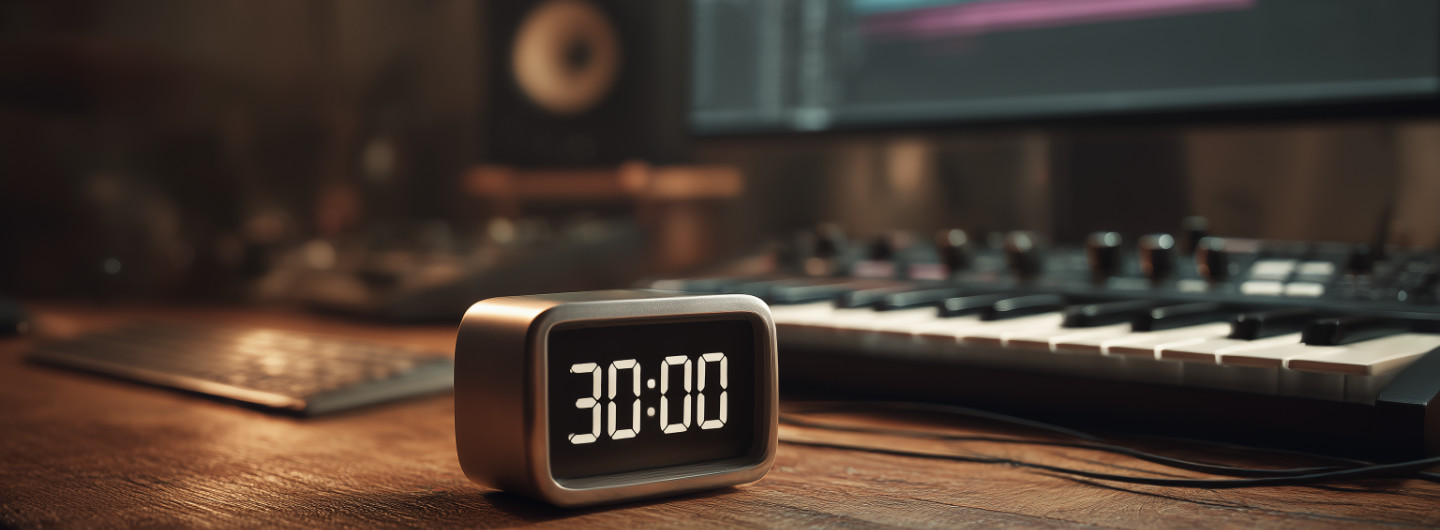
Set a timer for 30 minutes and work with intention. When the timer ends, stop and close the project. Be strict, even if things are going well – especially when things are going well!
A typical block, for me, looks like this:
- First 10 minutes: write a small hook, melody, or theme.
Eight bars are fine. Sixteen bars is great. Don’t overthink it.
- Next 15 minutes: give it movement
We don’t need a finished cue. Just some sort of arc or progression. Pick one lever: rhythm, harmony, or texture.
- Final minutes: bounce and close
Bounce a rough stereo mix and close the project. No polishing.
Remember: this stereo mix isn’t meant for release. It exists for one reason only: to make your brain say: “Yeah, I’ve accomplished something today!“
Knowing this takes a lot of weight off my shoulders, and I will probably do the same for you.
What makes this work from a psychological standpoint is not really what happens during the 30 minutes.
It’s a firm decision to stop when the timer rings and your 30 minutes end.
WHEN THE 30-MINUTE BLOCK DOESN’T WORK
There are days when 30 minutes feels wrong. They’re either too short for what I’m trying to do or maybe even too long. They could feel too unfocused, even.
When that happens, I don’t necessarily abandon the general idea, but I reduce the scope.
Some variations that work well for me:
- 15-minute micro blocks
Especially on low-energy days. I record just one idea, one hook, that’s it. Done.
- Single-focus blocks
I focus on only one element of an arrangement: the melody, the harmony, the rhythm, the FX.
- Sound sketching blocks
Choose any time limit. No structure. I just capture unique, interesting sounds, play around with a new synth, then bounce and close the project.
As you can see, the constant between those variations is having a fixed endpoint after which you turn to something else. This is important, as it gives you a sense of accomplishment and lets your brain reset.
This way of working also fits naturally into how I usually approach early trailer sketches.
Further reading: How To Create Cinematic Trailer Music
USING 30-MINUTE BLOCKS ACROSS A BUSY DAY
On busy days, I don’t try to protect long, uninterrupted writing sessions. They rarely happen anyway. Instead, I break my day into multiple 30-minute sessions, spread out wherever they fit.
Each block is self-contained. I start, commit to an idea, bounce, close, and step away.
Sometimes these blocks are all about the same project. Especially when I’m busy, I’ll split one larger cue into several 30-minute closes across the day or even across multiple days. Each block has a clear intention and a clear end. This breaks the pressure of one complex project, feeling like a chore. With each session, I’m starting a new, focused pass on the same piece.
What matters just as much as the block itself is what happens between them.
After each block, I take a short break away from the computer. Ten to fifteen minutes is enough.
I’ll walk, stretch, get water, or just get some fresh air. Anything that isn’t looking at a screen or listening to music.
Those breaks help reset my ears and my attention. When I come back, I’m not continuing the same session. I’m starting something new or working on something different.
That separation is important. It keeps the blocks from bleeding into each other and turning into one long, unfocused session.
CREATIVE STALLING (A TRAP I KNOW MUCH TOO WELL)
I’ve fallen into this trap more times than I can count.
Whenever I felt overwhelmed, insecure, or unsure about an idea, I’d suddenly find very good reasons to optimize my setup instead of making music.
I’d tweak my session. Reorganize tracks and folders. Refine my workspace. Clean up stuff that worked perfectly fine yesterday.
It felt responsible, like I was being professional. But often, it was an escape hatch. A way to stay busy without risking failure.
Taking care of those things isn’t useless, don’t get me wrong, but they’re comfortable. And comfort is often the opposite of creative momentum.
So I set a rule that helps me catch myself:
If a setup change doesn’t directly support what I’m working on right now, it probably doesn’t need to happen today.
Short working blocks make this very obvious. There’s simply no time to hide.
I’ve written about productivity before, but over time I’ve learned that doing more isn’t always the same as moving forward.
Further reading: 10 Tips To Boost Your Creative Productivity
HOW TO DECIDE WHICH IDEAS ARE WORTH FINISHING
Not every idea that comes out of a 30-minute session deserves to become a full cue. That took me a long time to accept. After some distance, I listen back and ask myself one simple question:
Does it still excite me?
Not “is this clever”. Not “could this be good if I worked on it more”.
Just: Does this pull me back in?
Many ideas don’t, and that’s fine. The few that do are usually very clear. Those are the ones I reopen.
STOPPING SOONER TO FINISH MORE MUSIC
It took me a while to accept that my best work often comes from many small, finished efforts, not one heroic session.
Short blocks lower the pressure to perform, stopping early preserves energy, and spacing sessions across the day makes it easier to keep going, even when things are busy.
But there’s another side effect I didn’t expect at first.
Working this way keeps the project exciting for me.
When I stop while something still feels alive, I don’t walk away drained. I walk away curious. I’ll catch myself thinking about the idea later, wanting to open the project again. Not because I should, but because I want to.
Projects stop feeling like something I have to push through with discipline and start feeling like something I’m looking forward to returning to.
Remember: you don’t need every session to lead to a finished cue. You just need enough finished moments of accomplishments to keep momentum alive.
If you try this for a few days, you’ll probably notice something shift. It will feel much easier to start again.
Finishing something always beats perfectionism.
And if you feel like sharing how it’s going, you can always write to me or comment below. I genuinely enjoy hearing how other people navigate this stuff and hope this concept is as helpful to you as it was to me.

As a working composer, finishing music has rarely been a technical problem for me. Whenever I struggled to get things done, it wasn’t because I lacked skills, tools, or ideas. If anything, I usually had too many of them. So if knowledge and workflow weren’t my problem, what kept me from getting things done, then? What I was missing was momentum.
That quiet sense of being in the zone and moving forward. Not preparing sessions. Not tweaking channel strips. Not “getting ready to create”. But actually creating something that exists.
Over the years, I’ve tried many ways to improve my music production workflow. One habit stuck because it does something very simple: it keeps me honest about how I use my time.
I simply call it my 30-minute sessions.
FINISHING MUSIC IS MOSTLY A MOMENTUM PROBLEM
When I sit down to write music without a clear idea or boundary, I almost always drift. I might fiddle around with a sound that’s already good enough and spend far too long chasing tiny improvements. Or I start questioning my scoring template, my plugin choices, or weirdly enough, even my color-doing. All of that feels productive, but none of it actually moves the music forward.
It’s not that my momentum comes to a sudden crash, but it slowly fades away until I get stuck.
The concept of this 30-minute block I’d like to share isn’t so much about writing great music as it is about protecting forward motion.
I’ve noticed that momentum often improves the moment I introduce clear limitations, whether that’s time, scope, or even restricting myself to a single sound source.
Further reading: Creating Trailer Music With ONE Sample Library Only
THE 30-MINUTE COMPOSITION BLOCK
The idea is simple by design.
Set a timer for 30 minutes and work with intention. When the timer ends, stop and close the project. Be strict, even if things are going well – especially when things are going well!
A typical block, for me, looks like this:
Eight bars are fine. Sixteen bars is great. Don’t overthink it.
We don’t need a finished cue. Just some sort of arc or progression. Pick one lever: rhythm, harmony, or texture.
Bounce a rough stereo mix and close the project. No polishing.
Remember: this stereo mix isn’t meant for release. It exists for one reason only: to make your brain say: “Yeah, I’ve accomplished something today!“
Knowing this takes a lot of weight off my shoulders, and I will probably do the same for you.
What makes this work from a psychological standpoint is not really what happens during the 30 minutes.
It’s a firm decision to stop when the timer rings and your 30 minutes end.
WHEN THE 30-MINUTE BLOCK DOESN’T WORK
There are days when 30 minutes feels wrong. They’re either too short for what I’m trying to do or maybe even too long. They could feel too unfocused, even.
When that happens, I don’t necessarily abandon the general idea, but I reduce the scope.
Some variations that work well for me:
Especially on low-energy days. I record just one idea, one hook, that’s it. Done.
I focus on only one element of an arrangement: the melody, the harmony, the rhythm, the FX.
Choose any time limit. No structure. I just capture unique, interesting sounds, play around with a new synth, then bounce and close the project.
As you can see, the constant between those variations is having a fixed endpoint after which you turn to something else. This is important, as it gives you a sense of accomplishment and lets your brain reset.
This way of working also fits naturally into how I usually approach early trailer sketches.
Further reading: How To Create Cinematic Trailer Music
USING 30-MINUTE BLOCKS ACROSS A BUSY DAY
On busy days, I don’t try to protect long, uninterrupted writing sessions. They rarely happen anyway. Instead, I break my day into multiple 30-minute sessions, spread out wherever they fit.
Each block is self-contained. I start, commit to an idea, bounce, close, and step away.
Sometimes these blocks are all about the same project. Especially when I’m busy, I’ll split one larger cue into several 30-minute closes across the day or even across multiple days. Each block has a clear intention and a clear end. This breaks the pressure of one complex project, feeling like a chore. With each session, I’m starting a new, focused pass on the same piece.
What matters just as much as the block itself is what happens between them.
After each block, I take a short break away from the computer. Ten to fifteen minutes is enough.
I’ll walk, stretch, get water, or just get some fresh air. Anything that isn’t looking at a screen or listening to music.
Those breaks help reset my ears and my attention. When I come back, I’m not continuing the same session. I’m starting something new or working on something different.
That separation is important. It keeps the blocks from bleeding into each other and turning into one long, unfocused session.
CREATIVE STALLING (A TRAP I KNOW MUCH TOO WELL)
I’ve fallen into this trap more times than I can count.
Whenever I felt overwhelmed, insecure, or unsure about an idea, I’d suddenly find very good reasons to optimize my setup instead of making music.
I’d tweak my session. Reorganize tracks and folders. Refine my workspace. Clean up stuff that worked perfectly fine yesterday.
It felt responsible, like I was being professional. But often, it was an escape hatch. A way to stay busy without risking failure.
Taking care of those things isn’t useless, don’t get me wrong, but they’re comfortable. And comfort is often the opposite of creative momentum.
So I set a rule that helps me catch myself:
If a setup change doesn’t directly support what I’m working on right now, it probably doesn’t need to happen today.
Short working blocks make this very obvious. There’s simply no time to hide.
I’ve written about productivity before, but over time I’ve learned that doing more isn’t always the same as moving forward.
Further reading: 10 Tips To Boost Your Creative Productivity
HOW TO DECIDE WHICH IDEAS ARE WORTH FINISHING
Not every idea that comes out of a 30-minute session deserves to become a full cue. That took me a long time to accept. After some distance, I listen back and ask myself one simple question:
Does it still excite me?
Not “is this clever”. Not “could this be good if I worked on it more”.
Just: Does this pull me back in?
Many ideas don’t, and that’s fine. The few that do are usually very clear. Those are the ones I reopen.
STOPPING SOONER TO FINISH MORE MUSIC
It took me a while to accept that my best work often comes from many small, finished efforts, not one heroic session.
Short blocks lower the pressure to perform, stopping early preserves energy, and spacing sessions across the day makes it easier to keep going, even when things are busy.
But there’s another side effect I didn’t expect at first.
Working this way keeps the project exciting for me.
When I stop while something still feels alive, I don’t walk away drained. I walk away curious. I’ll catch myself thinking about the idea later, wanting to open the project again. Not because I should, but because I want to.
Projects stop feeling like something I have to push through with discipline and start feeling like something I’m looking forward to returning to.
Remember: you don’t need every session to lead to a finished cue. You just need enough finished moments of accomplishments to keep momentum alive.
If you try this for a few days, you’ll probably notice something shift. It will feel much easier to start again.
Finishing something always beats perfectionism.
And if you feel like sharing how it’s going, you can always write to me or comment below. I genuinely enjoy hearing how other people navigate this stuff and hope this concept is as helpful to you as it was to me.
Share this: